
Ayudha Puja Book a Verified Pandit for Home, Office or Online
On Maha Navami, families and workplaces honour Goddess Durga, Saraswati and Lakshmi by worshipping the tools, books and vehicles that support their work.
Book Your Puja
Tailored spiritual experiences for every need

What is Ayudha Puja?
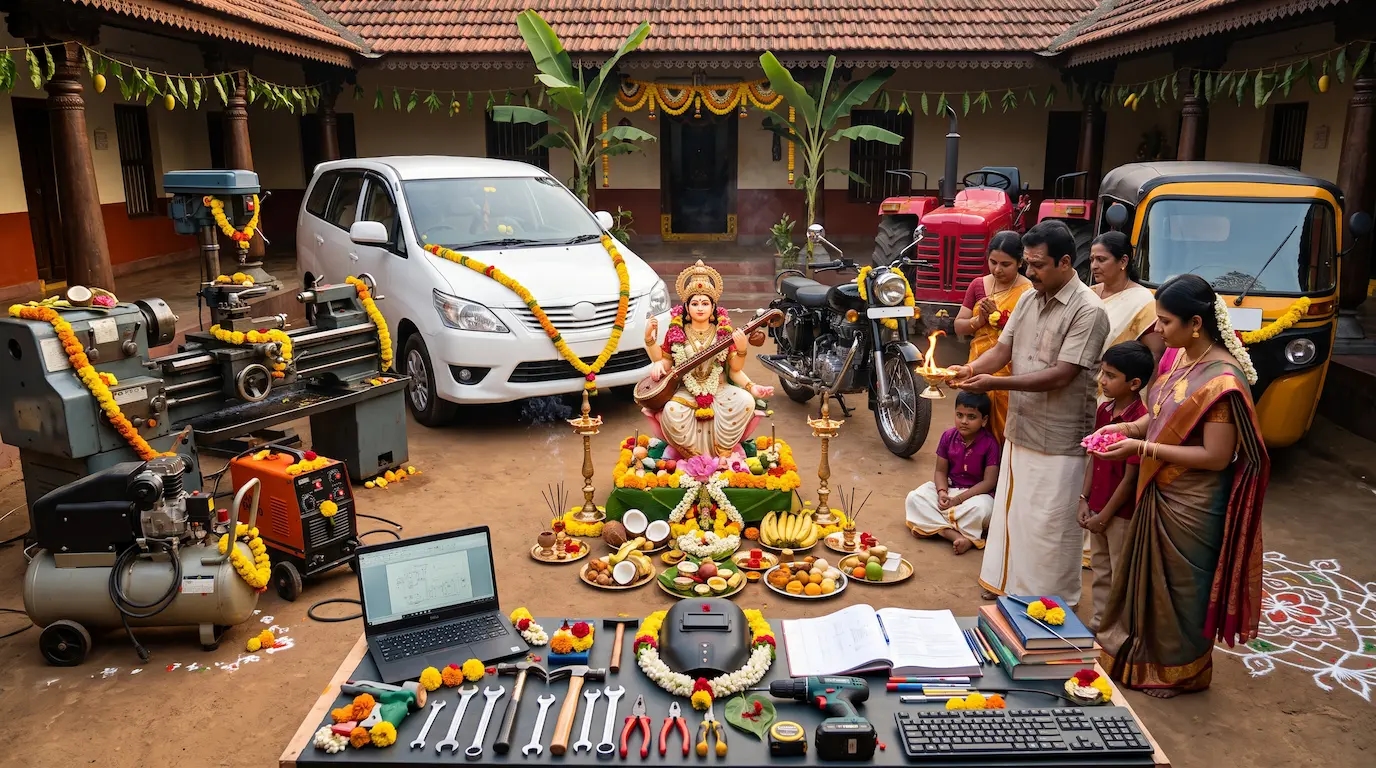
Ayudha Puja is the Hindu worship of tools, books, machines, and vehicles before Goddess Durga, Saraswati, and Lakshmi, performed on Navami, the ninth day of Navratri. Also called Shastra Puja or Astra Puja, it usually falls in September or October. The Ayudha Puja date changes every year.
Why Is Ayudha Puja Celebrated?
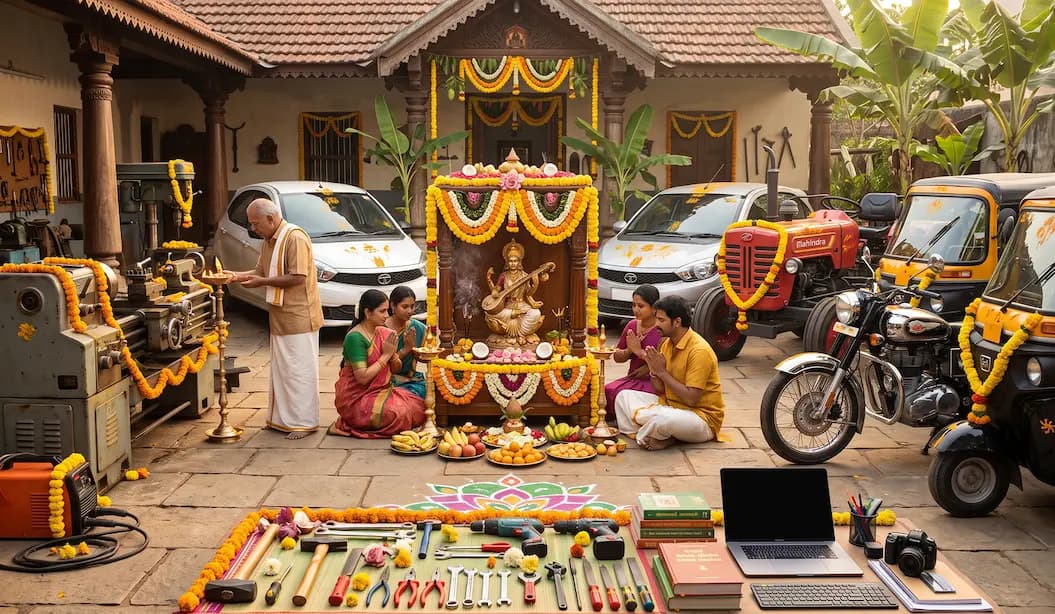
Ayudha Puja is celebrated to thank the tools, weapons and instruments that people work with, and to honour the Goddess whose power is believed to act through them. Three stories explain how the custom began. One comes from the Devi Mahatmya, one from the Mahabharata and one from the royal history of Mysuru.
Goddess Durga and the Weapons of the Gods
The Devi Mahatmya, part of the Markandeya Purana, tells how the gods each gave Goddess Durga a weapon to face the demon Mahishasura. Shiva gave a trident, Vishnu a discus and Indra a thunderbolt. With these she fought and slew him. In popular tradition, the weapons were laid down and honoured after the battle, and the Navami worship of tools remembers that moment.The Pandavas and the Shami Tree
According to the Virata Parva of the Mahabharata, the Pandavas hid their weapons in a Shami tree before spending a year in disguise in King Virata's kingdom. When the Kaurava army attacked, Arjuna took the weapons down and defeated it. Popular tradition places this on Vijayadashami. The Shami tree, called Banni in Kannada, is still honoured at Dasara for this reason.The Royal Tradition of Mysuru
The day also has a recorded royal history. The rulers of the Vijayanagara Empire kept Navratri as a state festival, and Raja Wodeyar I revived the practice in the Mysore kingdom in 1610. The Mysuru royal family still worships its weapons inside the palace on Maha Navami. Over time it became a people's festival, kept by every trade in Karnataka. Closing line, shown after the third story: Whichever story a family follows, the central act is the same: the tools rest for a day and are thanked, in the belief that the divine works through them.Ayudha Puja Samagri List
This is the samagri commonly used at home or at a workplace, with the items particular to this puja listed first.
- Ash gourd, also called white pumpkin (broken in front of vehicles; traditionally believed to remove drishti, the evil eye)
- Lemons (placed under the wheels of a vehicle in some regions)
- Banana stems and mango leaves (tied to vehicles, machines and doorways)
- Puffed rice, roasted gram and jaggery (the customary offering of this day in South India)
- Books, pens and musical instruments (placed for Saraswati Puja)
- Turmeric, kumkum and sandalwood paste (for the tilak on each tool)
- Marigold flowers and garlands (to decorate tools and vehicles)
- Pictures or idols of Goddess Durga, Saraswati and Lakshmi
- Kalash (a pot of water) and a coconut
- Betel leaves and areca nuts
- Bananas and other fruits
- Akshata (unbroken rice mixed with turmeric)
- Ghee or oil lamp, incense sticks and camphor
Ayudha Puja Vidhi: How to Do It at Home
These are the steps as commonly practised. Details vary by region and family custom.
- Clean every tool : Wash or wipe the tools, machines, books and vehicles you use for work. In many homes this is done on the evening before.
- Apply the tilak : Mark each item with turmeric, sandalwood paste and kumkum, then decorate it with flowers. Tie mango leaves or banana stems to vehicles and large machines.
- Set the altar : Place pictures of Goddess Durga, Saraswati and Lakshmi on a clean platform. Arrange small tools, books and instruments in front. Large machines are worshipped where they stand.
- Take the sankalp : Light the lamp and pray to Lord Ganesha first. Then take the sankalp (the stated intention of the puja), naming yourself, your family and your place.
- Worship the tools : Offer flowers, akshata, incense and the lamp to the goddess, then to each tool, while the mantras are recited. This is the heart of the puja.
- Offer the naivedya : Offer puffed rice, roasted gram, jaggery, fruits and a coconut to the goddess. The offering varies by region and family custom.
- Perform the aarti : Wave lit camphor before the goddess and then the tools. Share the prasad with family, staff or co-workers afterwards.
- Bless the vehicles : For Vahana Puja (vehicle worship), an ash gourd marked with kumkum is broken in front of the vehicle. In some regions lemons are placed under the wheels.
- Let them rest : By custom, the tools and books are not used for the rest of the day and are taken up again on Vijayadashami. This varies by family and workplace.
- A family can do the cleaning, decoration, offerings and aarti on its own. The sankalp, the mantras and any homa (fire ritual) are traditionally led by a pandit.
Significance of Ayudha Puja
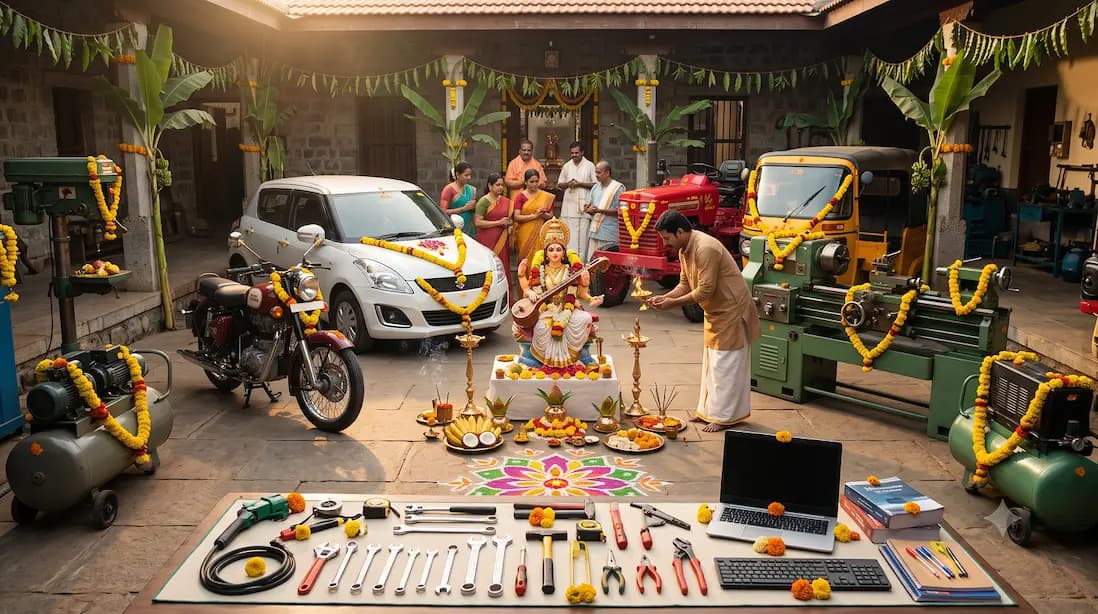
In Hindu tradition, Ayudha Puja teaches that work is sacred and that the means of earning a living deserve respect.

Gratitude for Your Tools
Traditionally observed to thank the instruments that earn a family's living, from a needle to a machine.

Work Seen as Worship
Each tool is treated as a form of the goddess, so the work itself becomes an offering.

A Day of Rest
Tools and books are set aside for the day, a pause before work resumes on Vijayadashami.

Learning Beside Skill
Saraswati Puja on the same day places books beside tools, honouring knowledge and craft together.
Get Your
FREE
Janam Kundali
Personalized Horoscope, Dosha & Yoga Analysis, Planetary Insights and Predictions.





 100% Accurate Predictions
 Trusted by Lakhs of Users
 Secure & Private
 24×7 Expert Support100% Accurate PredictionsTrusted by Lakhs of UsersSecure & Private24×7 Expert Support100% Accurate PredictionsTrusted by Lakhs of UsersSecure & Private24×7 Expert Support
Why Choose Us?
For authentic rituals, trusted pandits, and a seamless experience that bring divine blessings to your life.
10+
Google Ratings
500+
Get Instant Panditji
100+
Pooja Available
100+
Verified Panditji

Loading reviews...
How It Works
See how it works and simplify your puja booking experience.

Select Your Puja

Provide Your Details

Get Call From Us

Puja Confirmed
Frequently Asked Questions
Ayudha Puja is the worship of tools, books, machines and vehicles on Navami, the ninth day of Navratri. It is performed to thank the instruments that earn a family's living and to honour Goddess Durga, Saraswati and Lakshmi. Tradition links it to Durga's victory over Mahishasura in the Devi Mahatmya.
Ayudha Puja falls on the Navami tithi of Shukla Paksha in the month of Ashwin, the ninth day of Sharad Navratri. This usually comes in September or October, one day before Vijayadashami. Because a tithi follows the moon and local sunrise, the date can differ by a day between cities.
To do Ayudha Puja at home, clean your tools, books and vehicles, mark them with turmeric and kumkum, and decorate them with flowers. Place them before Goddess Durga, Saraswati and Lakshmi, light a lamp, offer puffed rice, jaggery and fruits, and perform the aarti. A pandit traditionally leads the sankalp and mantras.
