


Did you know that immediately after Diwali, a powerful festival is celebrated throughout India? It's known as Govardhan Pooja, a festival recalling the love and protection of Lord Krishna. On this day, followers worship Govardhan Hill and make an offering of a mountain of food in the shape of Annakut Puja, a representative of abundance and togetherness.
Celebrated with much enthusiasm in states such as Uttar Pradesh, Bihar, Rajasthan, and Gujarat, this festival is filled with spiritual significance. In this blog, we will learn about the date and time, the story of Govardhan Puja, how to do Govardhan Puja, and its significance.
What is Govardhan Pooja?
Govardhan Pooja, or Giri Govardhan Puja, falls on the fourth day of Diwali, which is the first lunar day of the bright fortnight (Shukla Paksha) in the month of Kartik (October–November).
On this day, people worship Govardhan Hill and Lord Krishna. The festival revolves around gratitude—giving thanks to nature and God for food, shelter, and protection. People celebrate Annakut Puja by giving thanks to a vast array of food, representing prosperity and abundance.
Story of Govardhan Puja
Govardhan Puja is a legend based on the sacred Hindu scriptures. The inhabitants of Vrindavan used to pray to Lord Indra, the Rain God, in order to receive rainfall on time for cultivation. But Krishna, who was young, defied this and asked the villagers to pray to the Govardhan hill also, as the hill granted fertile soil, grass for cows, and natural resources for survival.
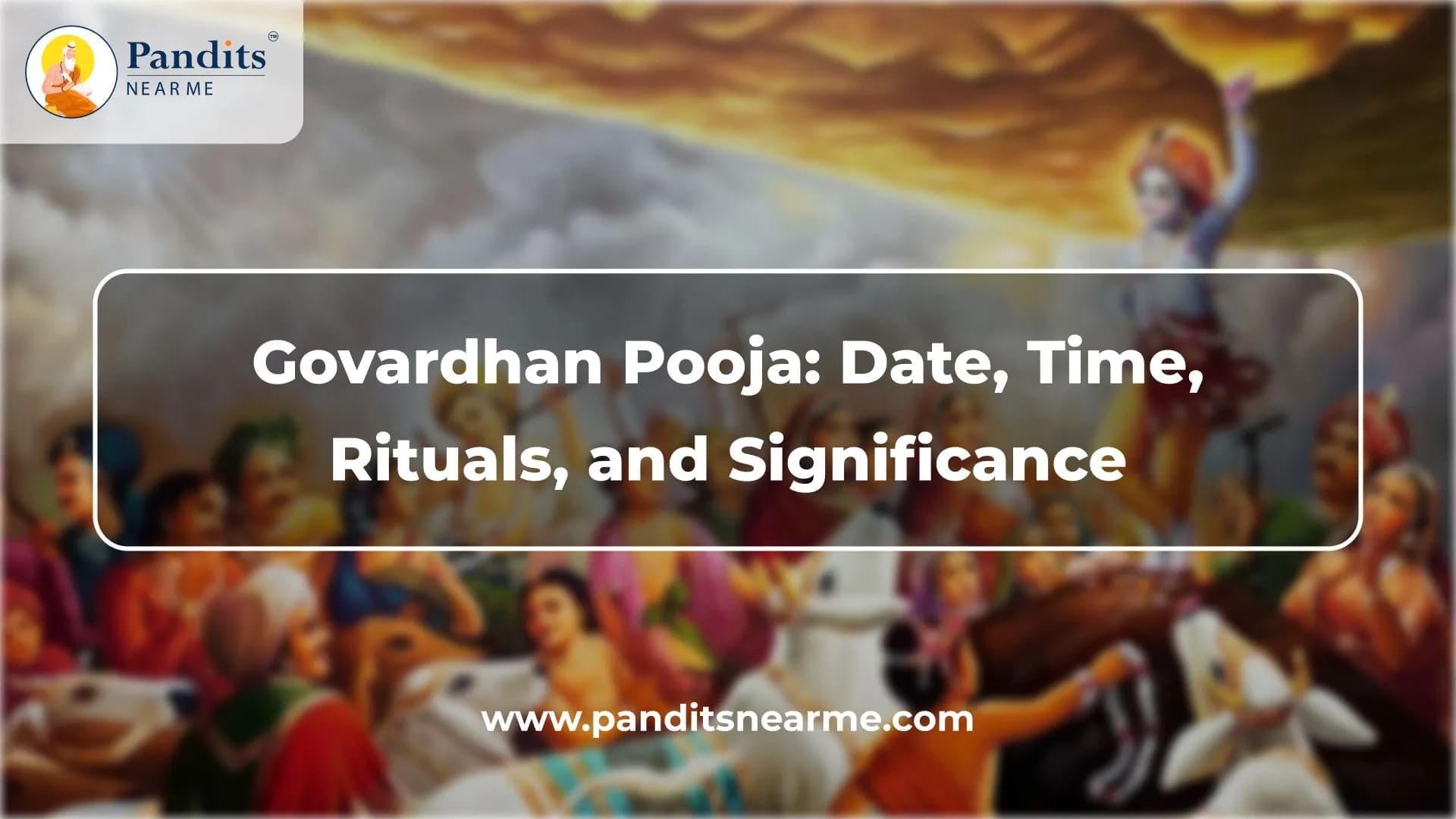
Enraged at this, Indra sent heavy rains upon Vrindavan. To shelter the villagers and cattle, Krishna raised the massive Govardhan hill upon his small finger and sustained it as an umbrella for seven consecutive days. Having realized his error, Indra ultimately gave up, and the day has since been celebrated as Govardhan Puja.
The Govardhan Puja katha not only narrates Krishna's divine power but also the significance of nature and thankfulness for its blessings.